
Rotation einer komplexen Zahl
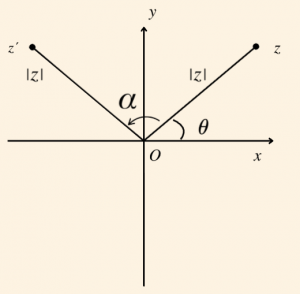
Wird der Bildpunkt der komplexen Zahl \( z = |z|(\cos \theta + i \sin \theta) \) in der komplexen Zahlenebene im mathematisch positiven Sinn (Gegenuhrzeigersinn) um einen Winkel \( \alpha \) gedreht, so gilt für die resultierende komplexe Zahl \( z‘ \):
\( z‘ = |z|[\cos(\theta + \alpha) + i \sin(\theta + \alpha)] \)
\( = |z|(\cos \theta + i \sin \theta)(\cos \alpha + i \sin \alpha) \).
Daraus folgt:
\[ z‘ = z(\cos \alpha + i \sin \alpha) \]
Wird der Bildpunkt der komplexen Zahl \( z = |z|(\cos \theta + i \sin \theta) \) im mathematisch negativen Sinn (Uhrzeigersinn) um einen Winkel \( \alpha \) gedreht, so ergibt sich für die resultierende komplexe Zahl \( z“ \):
\( z“ = z[\cos(\ – \ \alpha) + i \sin(\ – \ \alpha)] \).
Beispiel:
Bestimmen Sie die komplexe Zahl \( z‘ \), die durch eine Drehung von \( z = 2 + 4i \) im Gegenuhrzeigersinn um \( 60^\circ \) in der komplexen Zahlenebene entsteht.
\( z‘ = (2 + 4i)(\cos 60^\circ + i \sin 60^\circ) \)
\( = (2 + 4i)(\displaystyle\frac{1}{2} + \displaystyle\frac{\sqrt{3}}{2}\,i) \)
\( = 1 \ – \ 2\sqrt{3} + (2 + \sqrt{3})\,i \).